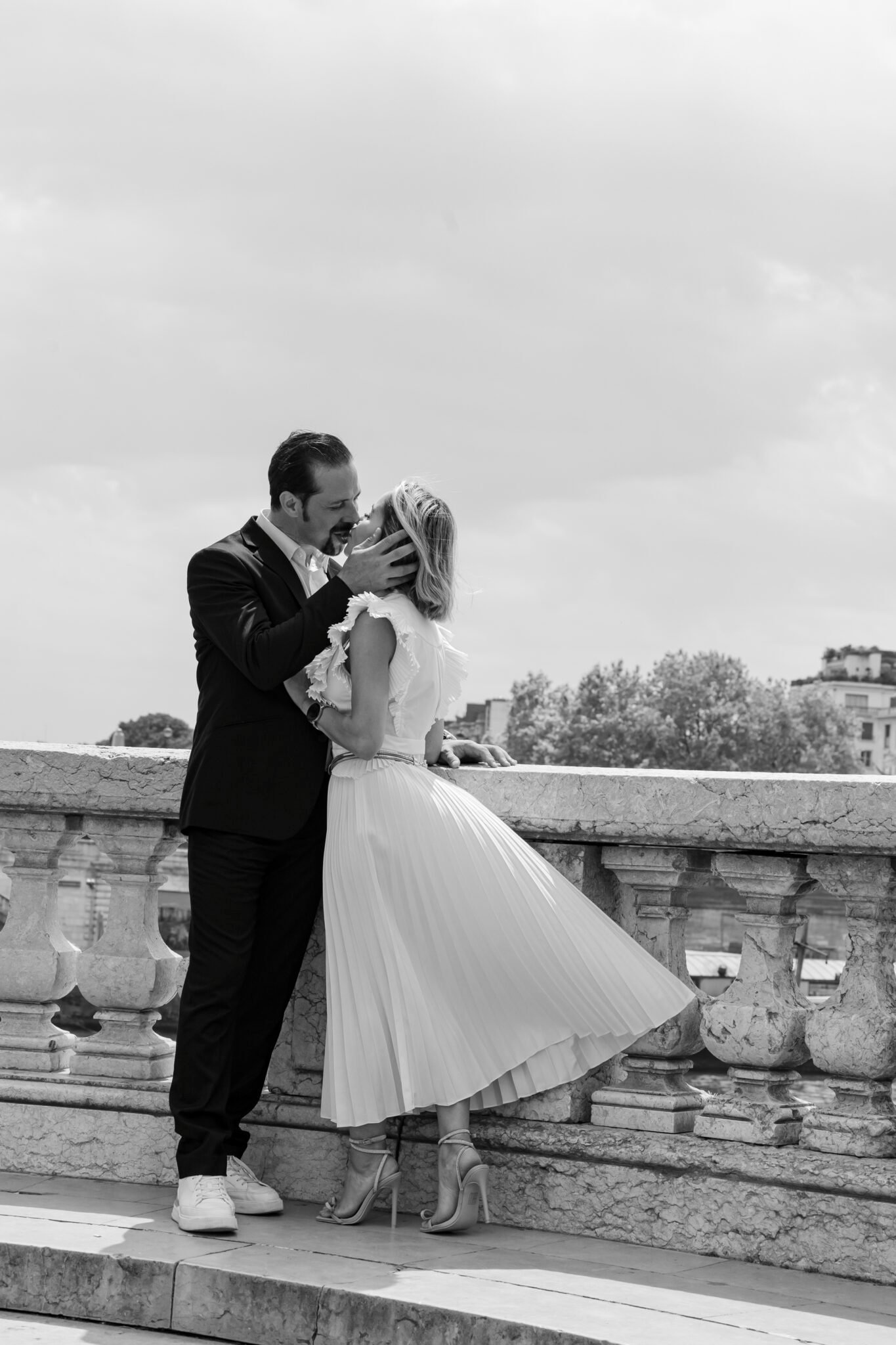
The Eiffel Tower is the most photographed monument on earth, and yet the difference between a snapshot and a truly beautiful Eiffel Tower photoshoot comes down to a handful of decisions: where you stand, when you arrive, how you frame the iron lady, and what you wear. As photographers based in Paris, we have spent years learning the light, the crowds, and the quiet corners around the Champ de Mars. In this complete guide we share every vantage point we rely on, the best times of day for each mood, and the practical rules that keep a shoot smooth. Whether you are planning a couple session, a solo portrait, or a flowing dress moment, this is the map we wish every visitor had before they arrived.
We write this as a working guide, not a list of clichés. You will find the classic postcard spots alongside the discreet streets that locals love, notes on avoiding the tour groups, and honest advice about accessibility, seasons and the tower's night lighting. If you would rather have us handle all of it for you, we run guided sessions in English, French, Portuguese and Spanish and deliver your images in a private online gallery. But even if you shoot on your own phone, everything below will make your photos better.
Why the Eiffel Tower is harder to photograph than it looks
At 330 metres, the tower is enormous, and that scale is exactly what trips people up. Stand too close and you crane your neck at a leaning triangle. Stand too far and it shrinks into the skyline. The magic sits in the middle distances, along specific sightlines where the architecture, the foreground and the light all line up. The other challenge is people: several million visitors a year converge on the same few metres of pavement, so timing matters as much as location.
Get those two variables right, position and timing, and the rest becomes easy. We have organised this guide around both. First the best vantage points, then the best times of day, then the craft that ties it together: composition, wardrobe, seasons, accessibility and the rules you should know.
The best vantage points for Eiffel Tower photos
These are the locations we return to again and again. Each has a distinct personality, and the right one for you depends on the mood you want, the time you can arrive, and how much walking you are willing to do. For a broader tour of the city beyond the tower, see our companion piece on the best photo spots in Paris.
Trocadéro esplanade: the postcard view
The Place du Trocadéro, across the Seine on the Right Bank, gives you the single most iconic head-on view of the tower. From the esplanade between the two wings of the Palais de Chaillot, the tower rises perfectly centred above the Jardins du Trocadéro and the Seine. This is the shot everyone pictures, and for good reason: nothing frames the monument so completely.
The catch is that everyone else knows it too. By mid-morning the esplanade is packed with tour groups, vendors and other photographers. Our strong advice is to arrive at sunrise, when the square is almost empty and the light is soft and directional. We regularly have the entire terrace nearly to ourselves at 6 or 7 in the morning, which lets us shoot clean, wide compositions impossible at any other hour.
Jardins du Trocadéro: greenery and the fountain
Just below the esplanade, the Trocadéro gardens offer a softer, more romantic take on the same view. The Warsaw Fountains, the lawns and the tree-lined paths give you foreground layers that add depth. Walk down the steps and shoot back up, or use the water features as a leading element with the tower behind. In spring and autumn the planting here is especially photogenic.
Pont de Bir-Hakeim: the cinematic bridge
If there is one spot that has exploded in popularity for a reason, it is the Pont de Bir-Hakeim. This two-level bridge with its elegant metal arches and central colonnade creates a natural frame, with the tower appearing at the end of the perspective. The rhythm of the pillars, the Art Nouveau ironwork and the diagonal sightline make it feel like a film set, which is exactly why it has appeared in so many movies.
Because it is now well known, it draws crowds and other photographers, particularly at sunrise and sunset. Come early. The light is best in the morning when the sun rises behind you and warms the tower. Mind the traffic: cars, cyclists and the overhead métro all share this bridge, so we always keep safety first and never linger in the roadway.
Avenue de Camoëns: the hidden balcony
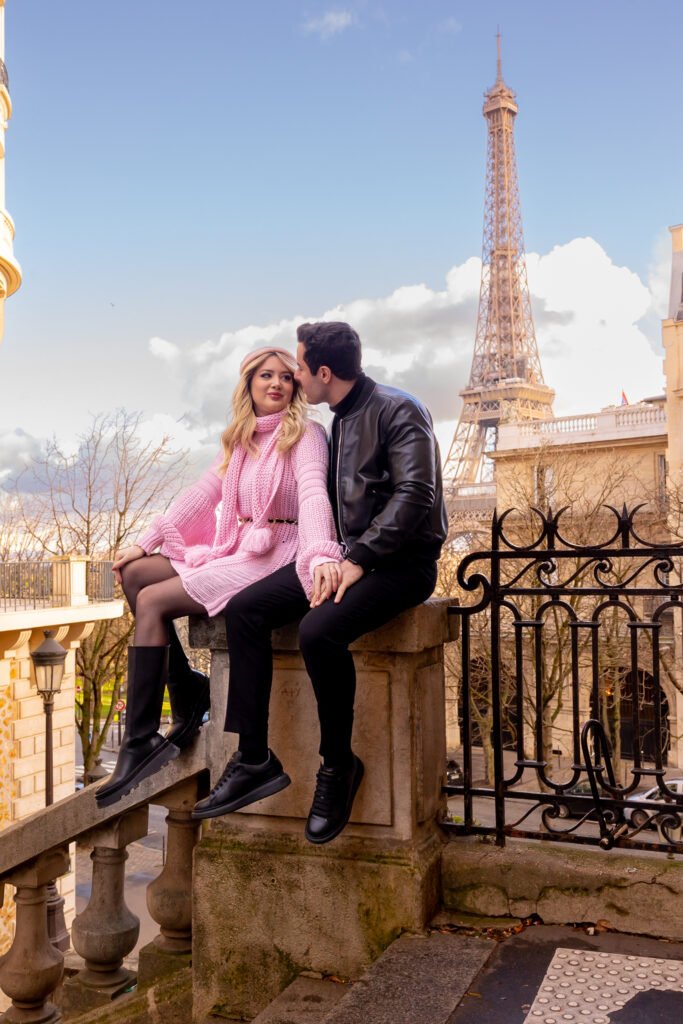
One of our favourite quieter locations, the Avenue de Camoëns in the 16th arrondissement is a short, elegant street that ends in a small balustraded terrace looking straight at the tower. Framed by Haussmann buildings on either side, it feels like a private stage. There is even a little staircase that adds a wonderful compositional element. It is far less crowded than Trocadéro, which makes it perfect for relaxed portraits and couple sessions.
Rue de l'Université: the effortless Parisian street
For the quintessential "the tower at the end of my street" photo, Rue de l'Université delivers. From the stretch around number 200 and beyond, the Eiffel Tower appears to sit right in the middle of a classic residential Parisian street, complete with balconies, café awnings and parked bicycles. It reads as authentically local rather than touristy, and it is one of the most versatile backdrops we use for editorial-style portraits.
Champ de Mars: at the foot of the tower
The long green lawn of the Champ de Mars stretches south from the base of the tower and gives you the classic "lying on the grass with the Eiffel Tower" composition. Here you are close, so the tower looms tall and dramatic behind you. It is ideal for full-length portraits, picnics, proposals and playful movement. The park is large enough that even when the immediate base is busy, you can walk a few hundred metres down the lawn and find breathing room.
Rue Saint-Dominique: café charm and the tower
Rue Saint-Dominique, especially the pretty junction near Rue Saint-Dominique and the Fontaine de Mars, offers that dreamy combination of a cobbled Parisian street, warm café terraces and the tower peeking above the rooftops. It is a wonderful spot for a morning coffee scene, a stroll, or a lifestyle sequence that feels lived-in rather than staged.
Square Rapp: the architectural secret
Tucked off Avenue Rapp, this small square hides one of the most surprising framing tricks in Paris: a narrow passage and the ornate Art Nouveau facade of number 29 Avenue Rapp, with the tower glimpsed through the gap. It is a spot photographers love precisely because so few visitors know it. The intimacy and the architectural detail make for striking, unexpected compositions.
Pont Alexandre III: the grand detour
While the most famous bridge, the Pont Alexandre III, faces the Grand Palais and Invalides rather than the tower directly, the sightlines from and around it, and the neighbouring quais of the Seine, offer beautiful angles where the tower sits across the water framed by ornate lamp posts and gilded statuary. It pairs a sense of Belle Époque grandeur with the tower and is worth including if you want variety in a longer session.
Best time of day for an Eiffel Tower photoshoot
Location sets the frame; light sets the mood. Paris light changes dramatically through the day, and choosing your hour is often more important than choosing your spot. For a deeper look at planning around the calendar and the clock, see our guide to the best time for a Paris photoshoot.
Sunrise: the empty city
Sunrise is our not-so-secret weapon. For roughly the first hour after the sun comes up, the most famous spots, above all Trocadéro and Bir-Hakeim, are nearly deserted. The light is gentle and golden, shadows are long and flattering, and you can compose freely without a single stranger in the frame. If clean, crowd-free images matter to you, nothing beats an early start. Yes, it means setting an alarm, but the results are unmatched.
Golden hour: warm and flattering
The hour after sunrise and the hour before sunset bathe the tower and your skin in warm, directional light. This is the most universally flattering time for portraits. West-facing and side-lit spots glow. Golden hour is busier than dawn but far kinder than harsh midday sun, which casts hard shadows and can blow out the sky.
Blue hour: the transition
The short window just after sunset, when the sky turns a deep cobalt blue and the city lights switch on, is pure magic. The tower's warm golden illumination glows against the cooling sky, creating a balance between ambient and artificial light that is impossible at any other moment. Blue hour is brief, perhaps twenty to thirty minutes, so we plan carefully to be in position before it begins.
Night and the hourly sparkle
After dark the tower wears its golden lighting, and on the hour, every hour, from nightfall until 11pm or midnight depending on the season, it bursts into a five-minute sparkle of thousands of flashing lights. It is one of the most joyful sights in Paris and a spectacular backdrop for a night portrait. Shooting the sparkle well requires steadying the camera and embracing a little movement and glow, but the payoff is unforgettable. Plan your timing around the top of the hour so you do not miss it.
How to avoid the crowds
Crowds are the number one thing that ruins Eiffel Tower photos, and they are also the most controllable. Here is exactly how we manage them.
- Go at sunrise. This is the single most effective tactic. Popular spots are empty for the first hour of daylight.
- Choose weekdays over weekends. Tuesday to Thursday mornings are noticeably calmer than Saturday and Sunday.
- Favour the lesser-known spots. Avenue de Camoëns, Rue de l'Université, Square Rapp and quieter stretches of the Champ de Mars stay peaceful even when Trocadéro is heaving.
- Avoid school holidays and peak summer midday when you can, as central Paris fills quickly.
- Shoot tight when needed. A longer focal length and a lower angle can compress the background and hide the people behind you.
- Keep moving. A short walk of even one hundred metres often trades a mob for an open frame.
Framing and composition tips
Once you have your spot and your light, composition is what turns a nice location into a memorable photograph. These are the principles we work with every day.
Mind the scale and the lean
The tower is tall, so if you tilt the camera up you will get converging, leaning lines. For a stately, upright tower, keep the camera as level as possible and step back rather than tilting. If you want a dramatic, towering feel, get low and shoot up deliberately, and let the lean become a choice rather than an accident.
Use foreground and framing elements
Depth is what separates a flat postcard from an image you want to look at twice. Use the arches of Bir-Hakeim, the staircase on Avenue de Camoëns, the trees of the Trocadéro gardens, a café awning on Rue Saint-Dominique, or the buildings of Rue de l'Université to frame the subject and lead the eye toward the tower.
Place the subject deliberately
Decide whether the person or the tower is the hero. For portraits, we often place the subject off-centre using the rule of thirds and let the tower balance the opposite side. For grand, symmetrical shots at Trocadéro, dead-centre works beautifully. Give your subject a little space to look into or walk toward.
Embrace movement
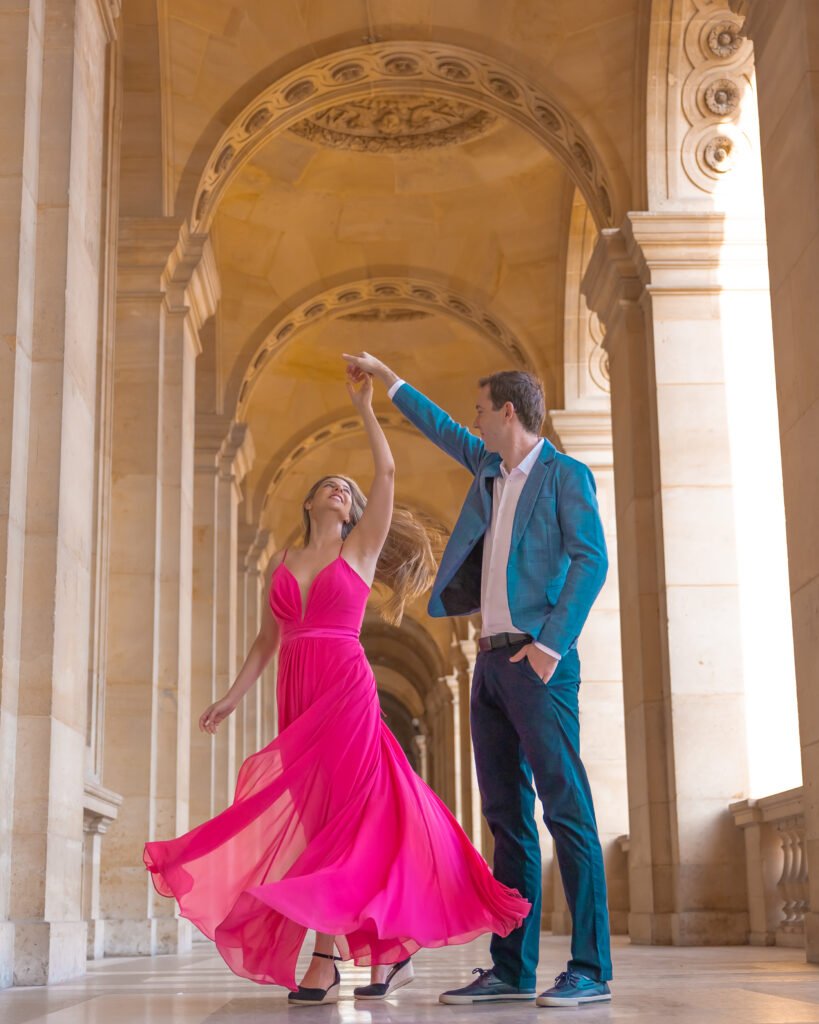
Static, stiff poses rarely flatter. A walk toward the camera, a twirl, a shared laugh, a flowing skirt caught by the breeze; motion brings life. This is exactly why a flying dress session works so well here, the fabric sweeping against the iron creates instant drama.
Watch your background details
Before pressing the shutter, scan the edges of the frame. Look for bins, distracting signs, or a stranger walking through. A small shift in position often cleans up the whole image. Consistency in these details is what makes a full gallery feel polished rather than accidental.
Wardrobe that pops against the tower
The Eiffel Tower's palette is grey-brown iron against Parisian sky and greenery, so the right wardrobe makes your subject stand out rather than blend in. Our recommendations:
- Bold, saturated colours read beautifully: classic red, deep emerald, cobalt blue, mustard and rich burgundy separate cleanly from the neutral backdrop.
- Flowing fabrics create movement: long dresses, silk, chiffon and anything with a hem that catches the wind photograph gorgeously, especially at golden hour.
- Timeless neutrals feel very Parisian: a camel coat, a crisp white shirt, a little black dress or a trench evoke effortless French style and never date.
- Avoid busy small patterns and logos, which fight for attention and can look dated quickly.
- Dress for the season and the walk: comfortable shoes matter, and layers let you adapt as the light and temperature change. You can always carry a statement piece and change into it for key frames.
Couples often look wonderful in coordinated but not identical palettes, one bold and one neutral, which keeps both people distinct against the tower. If you are planning a romantic shoot, our notes on a couple session in Paris go deeper into styling for two.
Seasons: the tower through the year
Every season reframes the Eiffel Tower, and each has its own reward.
Spring
Spring is arguably the most beautiful time. Cherry blossoms appear around the Champ de Mars and the Trocadéro gardens in late March and April, and magnolias add colour. The light is fresh, the greenery vivid, and the crowds have not yet reached their summer peak. Weather can be changeable, so plan for a mix.
Summer
Summer brings long days, with sunrise very early and sunset late into the evening, which extends your golden-hour options. It is the busiest season, so lean hard on early mornings and quieter spots. The lush green lawns of the Champ de Mars look their best.
Autumn
Autumn is a photographer's favourite. The trees around the tower turn gold and amber, the light grows soft and warm, and the tourist crush eases from October onward. Golden hour arrives at a civilised time, making it easier to plan a relaxed session.
Winter
Winter offers dramatic skies, crisp air and the fewest crowds of the year. The bare architecture of the tower stands stark and elegant, and on rare snowy mornings the scene is breathtaking. Days are short, so blue hour and the evening sparkle come early, which is convenient if you prefer not to shoot at dawn. Dress warmly and the empty spots are your reward.
Accessibility and getting there
The tower area is well served by public transport and largely accessible, though a few spots involve steps.
- Métro: Trocadéro (lines 6 and 9) for the esplanade; Bir-Hakeim (line 6) for the bridge; École Militaire (line 8) for the Champ de Mars; RER C Champ de Mars–Tour Eiffel.
- Step-free options: The Trocadéro esplanade, the Champ de Mars lawns and most Seine-side quais are broadly wheelchair and stroller friendly. Some viewpoints, such as the terrace steps on Avenue de Camoëns or the levels of Bir-Hakeim, involve stairs, so plan routes accordingly.
- Terrain: Expect cobbles on some streets and gravel paths in the gardens. Comfortable footwear helps everyone, and we are always happy to adapt a session to different mobility needs.
- Facilities: Cafés, benches and restrooms are available around the area, useful for wardrobe changes and breaks with children.
Rules and practical notes
A few regulations and courtesies keep your shoot smooth and respectful of the site.
- Drones are not permitted. Central Paris is restricted airspace, and flying a drone around the Eiffel Tower is prohibited. Do not plan on aerial footage here.
- Tripods: For personal photography, a small tripod in public outdoor spaces like the Champ de Mars or Trocadéro is generally tolerated, but large professional rigs, blocking walkways, or commercial productions may require authorisation and can be moved along by security. Keep setups compact and out of pedestrian flow, and be ready to adapt.
- Night lighting image rights: The daytime image of the Eiffel Tower is in the public domain, but the tower's illuminations and sparkling light show at night are considered an artistic work. Personal and social use of your night photos is completely fine; if you intend significant commercial publication of night images, it is wise to check the official guidance on rights. For ordinary travellers and portraits, this is not something to worry about.
- Security and courtesy: There is a visible security presence around the base. Follow signage, keep bags with you, and be mindful of others trying to enjoy and photograph the same view.
- Safety on bridges and streets: Watch for traffic on Bir-Hakeim and never step into roadways for a shot. Your safety always comes first.
Planning a session with us
We love this monument, and after countless mornings on the Trocadéro terrace we know how to move quickly between spots to make the most of the light. Our guided sessions are run in English, French, Portuguese and Spanish, we scout the timing and crowds for you, and your edited images arrive in a private online gallery. Our work has earned a 4.9-star rating on Google, and you can get a feel for our style in our portfolio. When you are ready to plan the details, our pricing page lays out how sessions work.
However you choose to shoot the Eiffel Tower, remember the two levers that matter most: arrive early, and pick the vantage point that matches the mood you want. Do that, and the most photographed monument in the world will still give you an image that feels entirely your own.
Frequently asked questions
Where is the best place to photograph the Eiffel Tower?
The Trocadéro esplanade offers the classic head-on postcard view of the entire tower. For something more cinematic, the Pont de Bir-Hakeim frames it beautifully, and for quieter, more intimate shots we love Avenue de Camoëns, Rue de l'Université and Square Rapp.
What is the best time of day for Eiffel Tower photos?
Sunrise gives you empty, crowd-free spots and soft light. Golden hour is the most flattering for portraits, blue hour just after sunset is the most atmospheric, and the night sparkle on the hour is spectacular. Our overall favourite is sunrise for the freedom it gives.
How do I avoid the crowds at the Eiffel Tower?
Arrive at sunrise, choose weekday mornings over weekends, and favour lesser-known spots like Avenue de Camoëns or quieter stretches of the Champ de Mars. Even a short walk from the busiest pavement usually opens up a clean frame.
Can I bring a tripod for photos at the Eiffel Tower?
For personal photography, a small, compact tripod is generally tolerated in public outdoor spaces like the Champ de Mars and Trocadéro. Large professional setups, blocking walkways, or commercial shoots may require authorisation and can be asked to move, so keep it small and out of the way.
Are drones allowed to film the Eiffel Tower?
No. Central Paris is restricted airspace and flying a drone around the Eiffel Tower is prohibited. Do not plan on aerial footage in this area.
What should I wear for an Eiffel Tower photoshoot?
Bold saturated colours like red, emerald or cobalt stand out against the tower's neutral iron. Flowing fabrics create beautiful movement, and timeless Parisian neutrals such as a camel coat or little black dress always work. Avoid busy small patterns and prominent logos.
Is it free to photograph the Eiffel Tower?
Yes, photographing the tower from public streets, parks and bridges is free. The daytime image is in the public domain. Only the illuminated night light show has image-rights considerations for significant commercial use; personal and social sharing is fine.
What is the Eiffel Tower sparkle and when does it happen?
Every night, on the hour for five minutes from nightfall until around 11pm or midnight depending on the season, thousands of lights flash across the tower in a golden sparkle. Plan to be in position just before the top of the hour to catch it.
Which spot is best for a couple or engagement photoshoot?
Avenue de Camoëns and the Champ de Mars are wonderful for couples, offering romance without the biggest crowds. The Trocadéro at sunrise is ideal for a grand, sweeping image. We tailor the route to the mood you want.
Is the Eiffel Tower area accessible for wheelchairs and strollers?
Largely yes. The Trocadéro esplanade, the Champ de Mars lawns and the Seine-side quais are broadly step-free. A few viewpoints, such as the terrace steps on Avenue de Camoëns and the levels of Bir-Hakeim, involve stairs, so we plan accessible routes when needed.
What is the best season to photograph the Eiffel Tower?
Spring brings cherry blossoms and fresh light, autumn offers golden foliage and thinner crowds, summer gives long golden hours, and winter delivers dramatic skies and the emptiest spots. Each season has its own charm; spring and autumn are our personal favourites.
Do you offer guided Eiffel Tower photoshoots?
Yes. We run guided sessions in English, French, Portuguese and Spanish, handle the timing and crowd strategy for you, and deliver your edited photos in a private online gallery. You can see our style in our portfolio and find session details on our pricing page.